
Back Pain According to the 5 Biological Laws
Back pain is one of the most widespread complaints today, yet according to the 5 Biological Laws developed by Dr. Hamer it is not a random disorder…

In conventional medicine, haemorrhoids are generally described as a local medical problem, linked to a structural weakening of the veins of the rectum and often associated with constipation, straining or diet. According to the biological approach of the 5 Biological Laws, however, this complaint takes on a broader and more coherent explanation.
In this view, disease is not a mistake but meaningful biological information: a precise adaptation involving psyche, brain and organ. Haemorrhoids are the final manifestation of a conflict process linked to territory, identity, one’s place in society and the management of one’s own living space, on both the masculine and the feminine level.
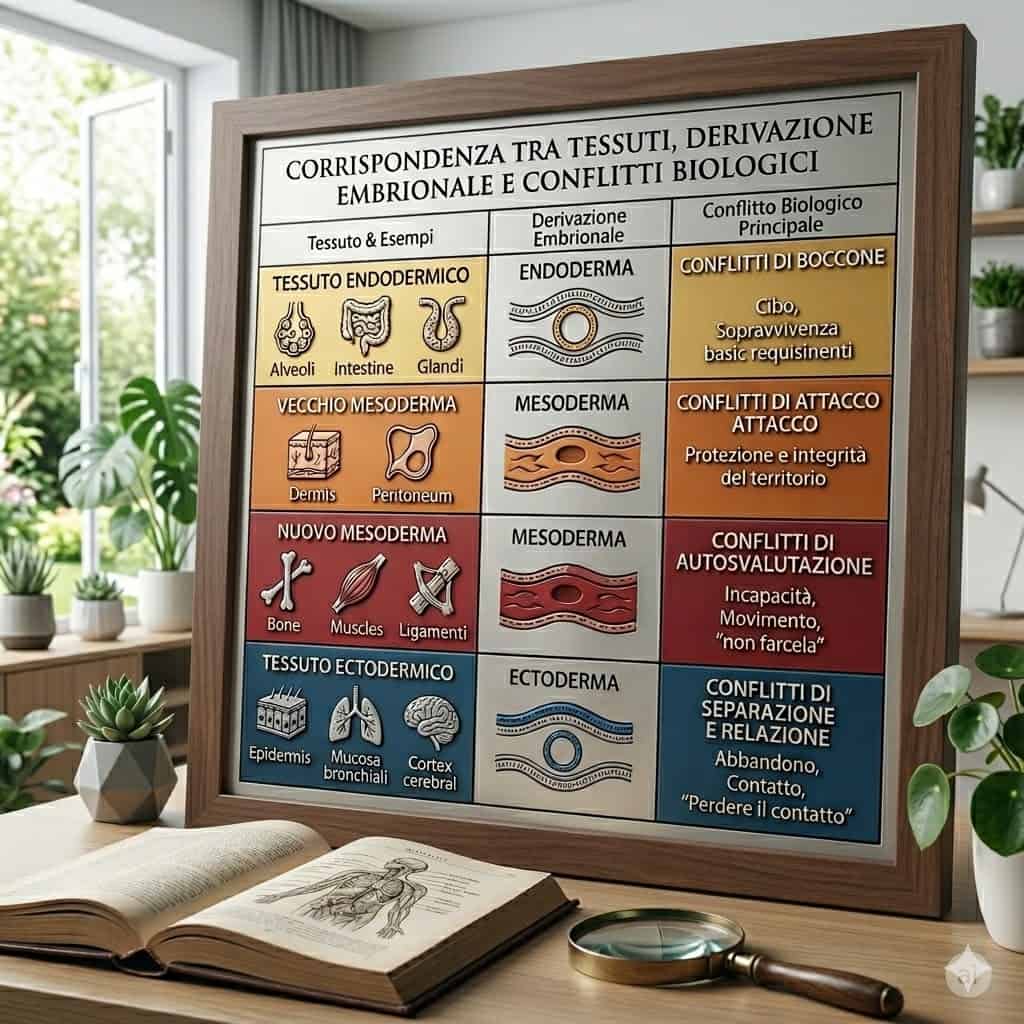
To truly understand haemorrhoids, it is essential to look at the location of the tissue involved, because each embryonic layer responds to themes relating to different conflicts. This is where New Medicine differs from symptom-based medicine: it does not merely treat the symptom, but seeks its origin.
The mucosa of the rectum, controlled by the brain (sensory cortex), is linked to the territorial conflict and the identity conflict:
“Who am I here?”, “Where is my place?”, “Where do I belong?”.
Active phase: during the conflict, often experienced with anger, fear, frustration or a sense of injustice, the mucosa develops micro-ulcerations. This is an active phase: silent and often painless.
Resolution and repair phase: once the conflict is resolved, the repair phase begins. This is when visible haemorrhoids appear: swelling, oedema, bright red bleeding and pain. The complaint becomes painful, yet paradoxically this shows that the biological process is moving towards balance.
In the case of a constellation (several conflicts at the same time), the picture can become chronic, creating a vicious circle.
When the mesodermal tissue is involved, the theme shifts to self-devaluation and the inability to “hold one’s position”.
Here the experience is often: “I can’t assert myself”, “I feel crushed”, “I have no strength”.
The dilation of the haemorrhoidal veins works as a biological response to emotional pressure that has not been dealt with. This kind of suffering is often connected to states of depression, chronic tiredness and a loss of direction.
In the deepest layers, the endoderm reacts to conflicts perceived as a dirty trick, an injustice, moral filth or “something indigestible”. It is the classic morsel that one cannot eliminate.
This type of conflict can also be linked to food-related, family or work dynamics, and sometimes involve other organs such as the pancreas, when the theme concerns survival or a lack of “sweetness” in life.
The side involved (right/left) gives a valuable indication of the kind of relationship or situation experienced: mother, partner, work, clan, authority.
Haemorrhoids are not a random event but a meaningful manifestation of a biological process. Understanding the complaint means stepping outside the logic of conventional medicine alone and into an integrated view, where every symptom tells a story of adaptation, suffering and a possible return to balance.
Back pain is one of the most widespread complaints today, yet according to the 5 Biological Laws developed by Dr. Hamer it is not a random disorder…
A synoptic table of tissues by body system, showing the correspondence between tissues, embryonic derivation (germ layers) and biological conflict…
To truly understand the common cold and rhinitis according to the 5 Biological Laws, we need to start from one fundamental principle…