
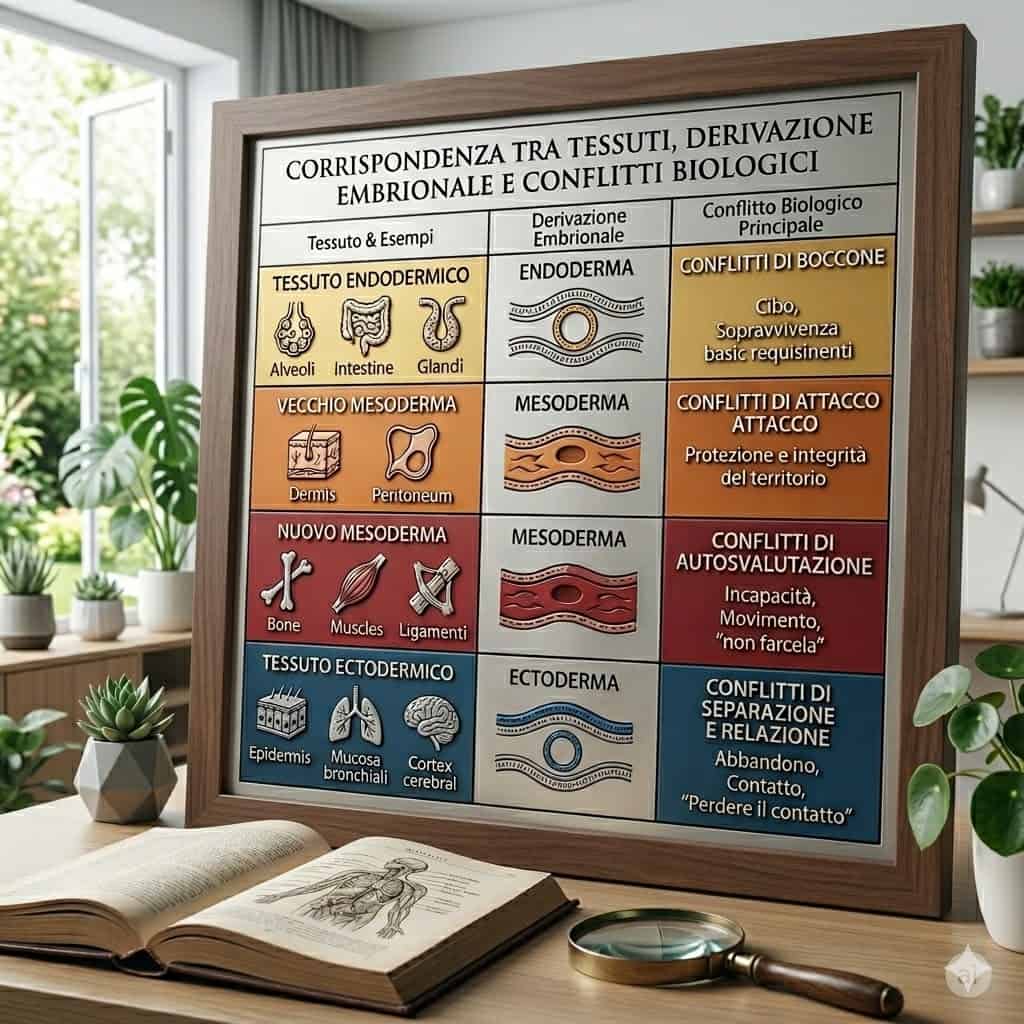
Tissues, Embryonic Derivation and Biological Conflicts
A synoptic table of tissues by body system, showing the correspondence between tissues, embryonic derivation (germ layers) and biological conflict…

Back pain is one of the most widespread complaints in today’s population, yet according to the 5 Biological Laws developed by Dr. Hamer it is not a random disorder. Pain in the spine is the expression of a Significant Biological Special Program (SBS) involving tissues that derive embryologically from the new mesoderm — bones, cartilage, muscles, ligaments and tendons — directed by the cerebral white matter. Understanding this physiology means giving spinal symptoms a new meaning and reading them as coherent signals, not as mistakes made by the body.
At the root of all spinal pain, from neck pain to low back pain, from disc herniation to scoliosis, lies a common conflict: self-devaluation. It is the psychosomatic perception of not feeling good enough, of being unable to bear an emotional, professional or relational burden. The specific area of the spine affected reveals the content of the devaluation.
The cervical spine (C1-C7) reflects an intellectual or moral devaluation, “having to bow one’s head”. The upper thoracic spine (T1-D3) expresses an excessive load of obligations and responsibilities, while the mid-thoracic spine (D4-D9) evokes feeling caught in a vice, with no room to live and no freedom to breathe.
Pain in the upper lumbar area (D10-L2) points to being unable to break free from someone who dominates us, a situation typical of workplace bullying. The lumbar area proper (L3-L5) holds the deepest devaluation of the personality: feeling a failure as a partner, parent or worker. The lumbosacral spine, the sacrum and the pubic bone concern sexual or family devaluations, while the coccyx holds the experience of being ridiculed.
Every spinal symptom follows a precise and reproducible two-phase curve.
During the conflict-active phase, marked by constant stress and obsessive thinking, bone or cartilage necrosis takes place. Paradoxically, this phase is painless: the person feels no discomfort in the back, even though the tissue is weakening. During this interval the biological conditions may arise for a future herniation or for muscle weakness and stiffness.
Only once the conflict has been resolved does repair begin: an oedema regenerates the necrotised tissue, swelling the vertebra or the intervertebral disc. Since bone has no pain receptors, the suffering comes from the stretching of the periosteum, an extremely sensitive membrane. The pains of recalcification are among the most intense described in medicine.
When an active conflict of loneliness or abandonment is added to the repair, the renal collecting tubules retain fluids that amplify the vertebral oedema. The pressure on the periosteum and on the sciatic nerve can turn bearable discomfort into pain of extreme intensity, which may radiate down the leg and into the lower body.
The pain itself, by generating fear and tension, can trigger a new devaluation: the person perceives themselves as inadequate and physically impaired. This sets off local relapses that make the condition chronic, creating a vicious circle that is hard to break without looking more closely into the deeper causes and relational dynamics.
The side on which the symptom appears indicates with whom the conflict was experienced. For a right-handed person, the left side concerns the nest (mother, children), the right side the partner and peers. For a left-handed person the reverse applies.
The biological meaning of this process, called the “Luxury Group”, emerges at the end of healing: the recalcified bone is stronger than before, better prepared to bear future loads. A genuine osteo-articular reawakening that gives renewed support to the spine.
Seen through this lens, back pain stops being an enemy and becomes a messenger. Identifying the underlying conflicts, the relationships involved and the body’s response makes it possible to bring awareness back into one’s own life and health.
A synoptic table of tissues by body system, showing the correspondence between tissues, embryonic derivation (germ layers) and biological conflict…
To truly understand the common cold and rhinitis according to the 5 Biological Laws, we need to start from one fundamental principle…
Conventional medicine sees haemorrhoids as a local problem of the rectal veins; the 5 Biological Laws read them as the sign of a deeper conflict…