
Back Pain According to the 5 Biological Laws
Back pain is one of the most widespread complaints today, yet according to the 5 Biological Laws developed by Dr. Hamer it is not a random disorder…

Cold sores are one of the most common skin manifestations and, according to the biology of the 5 Biological Laws, each outbreak carries a precise meaning. In this model of interpretation, no symptom is random: every manifestation represents a functional adaptation of the organism to a specific emotional experience.
Dr. Hamer’s discoveries offer a view in which the body acts in an orderly, meaningful and scientific way, following biological programmes aimed at survival. In this context, a cold sore is not a disease to be fought, but the complete and coherent outcome of a Significant Biological Special Program (SBS), governed by the brain and closely connected to the nervous system and the sensory nerve.
According to biology, a cold sore does not arise from an external attack, but emerges in the repair phase of a programme involving ectodermal tissues, in particular the skin and the mucous membrane of the lip, a part of the body that is highly sensitive to contact.
The herpes virus comes in to repair only once the conflict has been resolved, taking part in the process with the aim of supplying genetic material: actual DNA sequences that will be used to regenerate and rebuild cells. Its function is not destructive but reparative: it comes in to repair the small ulcerations produced in the active phase, optimising tissue healing.
Understanding this mechanism makes it possible to observe the symptom in a more aware way, with greater clarity and without alarmist interpretations.
From a clinical point of view, herpes appears as blisters and swelling, followed by a crust. From a biological point of view, the process always has two phases:
The local sensation, the moment of onset and the location of the lesion offer valuable information about the content of the conflict and the relational sphere involved.
The initial phase begins with a sudden biological shock, experienced in isolation. It is a separation conflict that sensitises the skin, often linked to a real or symbolic loss of contact.
In this phase:
The biological purpose is to reduce the perception of the pain linked to the separation, as if the body wanted to “anaesthetise” the experience.
When the conflict is inwardly resolved, the body enters the healing phase. This can happen when:
This is when the herpes virus comes in to repair the small ulcerations that had formed in the active phase, providing bodily information useful for cell regeneration.
Swelling, redness and blisters are therefore a sign of healing, not of worsening.
At the peak of the repair, a brief flare-up of the local sensation may occur, followed by the blisters drying out, a crust forming and a return to normal. Itching indicates that the process is nearly complete.
The biological content is:
a separation conflict
The event does not have to be real: it can be interpreted in a symbolic form or relate to what the person is experiencing inwardly.
Biological handedness helps identify the relationship involved.
Right-handed person:
Left-handed person: the reading is reversed
Example: A cold sore on the upper left lip of a right-handed woman may indicate a resolved emotional separation from a child or from her mother.
Upper lip
Linked to contact, to the desire for closeness, to the kiss as the primary gesture of connection.
Lower lip
Linked to expression, to what has not been said, or could not be said or communicated.
The kiss can be interpreted biologically as an act of union, contact and recognition. Its absence or interruption can activate the programme; its return, or working through it emotionally, starts the repair.
Recurring events such as “sun-triggered cold sores” fall under the concept of tracks: if the sun was present during the initial conflict, it can reactivate the programme on later occasions of repair and symptoms.
According to this model, herpes is not contagious: the microbe acts only if the personal conflict has already been resolved.
Read biologically, a cold sore becomes a tool for deep understanding. It allows us to assess what we have been through, recognise the connection between emotion and body, and grasp the evolutionary potential of the symptom.
Every manifestation, when observed with attention and awareness, offers an opportunity for growth, integration and deeper listening to oneself.
Back pain is one of the most widespread complaints today, yet according to the 5 Biological Laws developed by Dr. Hamer it is not a random disorder…
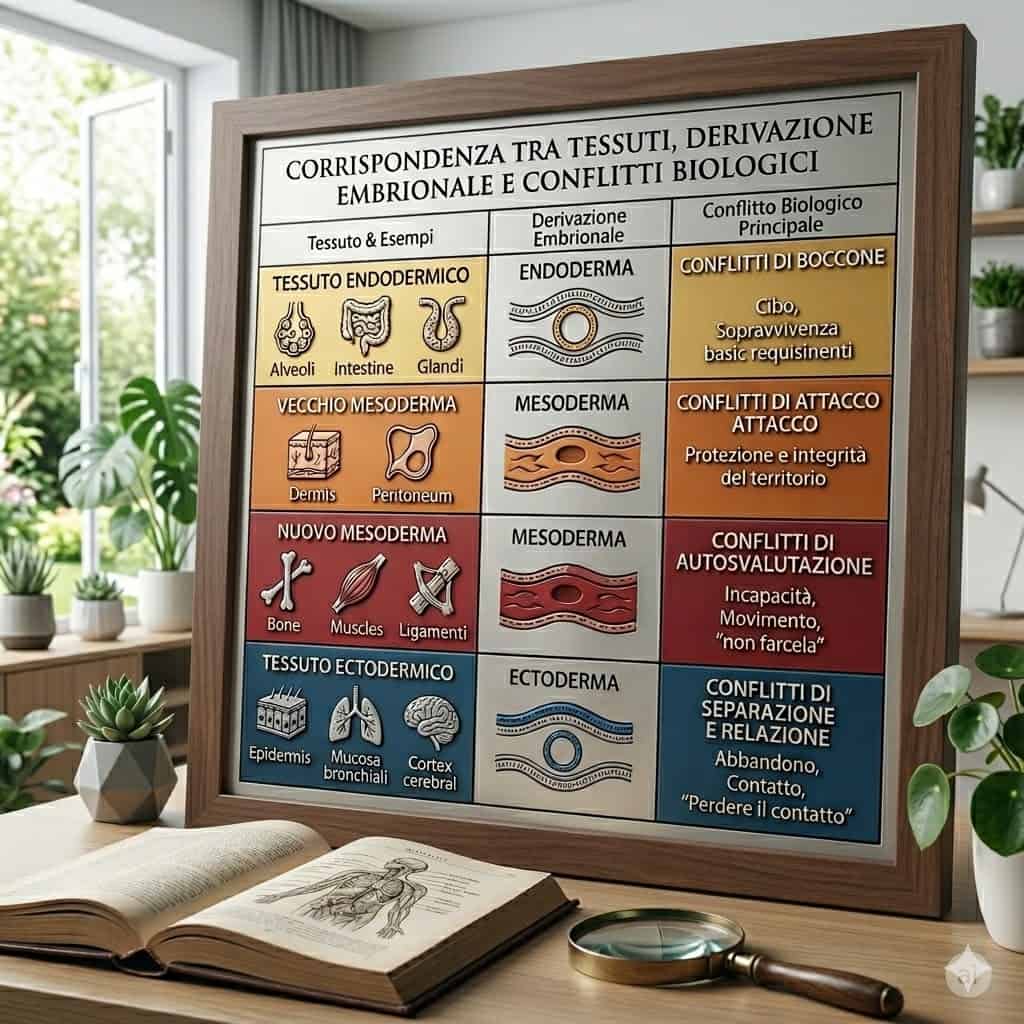
A synoptic table of tissues by body system, showing the correspondence between tissues, embryonic derivation (germ layers) and biological conflict…
To truly understand the common cold and rhinitis according to the 5 Biological Laws, we need to start from one fundamental principle…